loading...
Tampilkan postingan dengan label knee injuries. Tampilkan semua postingan

Senin, 28 September 2015

Patellar Femoral Syndrome - Part I


“When there is alignment and understanding, it is much easier to navigate forward together, ” - Karen Kimsey-House


          The knee is one of the most relied upon joints of the human body and is subjected to a great deal of force every day. During a simple activity like walking, the amount of force placed upon this joint is equal to anywhere from one-third to one-half an individual's body weight. When a person is climbing stairs the force placed upon the joint is equivalent to 3 times the individual's body weight, and when squatting, the knee must manage a force equal to 7 times the individual's body weight. When considering these facts, it is easy to understand that there must be a great amount of stress placed upon the knee in all kinds of dance. When the knee joint is functioning correctly, it is usually able to cope with this stress, however, when something is misaligned, and the knee joint is not functioning efficiently, the stress can be detrimental.


        Patellar femoral syndrome is a chronic condition in which the patella, or knee cap, is not correctly aligned. The patella is a triangular shaped bone that lies on top of the femur, or thigh bone. There is a groove in the femur which allows the patella to slide back and forth as the knee bends and extends. When the patella is not in alignment, it does not fit well into this groove, and the friction of the patella against the femur begins to wear away the cartilage found in the joint.


          When the knee joint is at rest, the patella is held in place by the capsule surrounding the joint, the ligaments on either side of the patella (the retinaculum), and the patellofemoral ligament, which connects the femur to the patella.

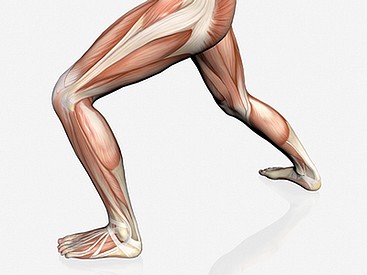
When the knee is actively bending or extending, the joint's stability is provided by the quadriceps (the four muscles located on the front of the thigh), the vastus medialis (which is a muscle that is found on the inner side of the thigh), the vastus lateralis (which is a muscle that runs along the outside of the thigh), and the iliotibial band, which runs from the gluteal muscle of the buttocks down the outside of the thigh.

          Dancers with patellar femoral syndrome will experience pain behind and around the kneecap during activities that require the knee to bend like squatting, jumping or climbing stairs. Occasionally, the dancer will also experience the knee buckling, or "giving way" when walking and may also complain of stiffness in the knee after sitting for a while.

          Any dancer experiencing these symptoms should rest the joint and use ice and anti-inflammatories to control the discomfort. The dancer should also contact a sports or dance medicine doctor to get a complete diagnosis. In most cases, once the cause is determined, physical therapy can help alleviate the symptoms and help realign the kneecap.

          Since an ounce of prevention is worth a pound of cure, my next post will focus upon the causes of patellar femoral syndrome and how to prevent this condition from occurring.

Senin, 16 September 2013

Acute Knee Injuries

         "There are three steps you have to complete to become a professional dancer: learn to dance, learn to perform, and learn how to cope with injuries." -D. Gere

       Acute injuries are those that occur as a result of a specific action or trauma.  They manifest themselves immediately and will usually heal in a set amount of time compared to chronic injuries which develop over time and can take a relatively long time to heal.

          The knee joint is cushioned by C-shaped discs of cartilage called menisci.  These discs lay between the femur, or thigh bone, and the tibia, or larger shin bone.  When a dancer lands a jump poorly or twists, or torques, the knee, one or both of these discs can tear.  A minor tear will cause delayed pain, but a more severe tear will cause immediate pain accompanied by swelling.  As with all injuries, ice, rest, elevation, and anti-inflammatories will help when the injury first occurs.  A physical therapist can usually help the dancer through rehabilitation exercises although severe tears may require surgery.

          Another common acute injury among dancers and athletes is a torn ligament. 

           The medial collateral ligament, or MCL, runs along the inside of the knee and limits sideways movement of the femur.  This ligament can be torn as a result of trauma from twisting, jumping, or turning.  The dancer will experience immediate pain on the inside of the knee.  The area will be painful to touch, and the knee's range of motion will be severely limited.  Ice, rest, elevation, and anti-inflammatories will help limit the swelling and ease the pain. Minor tears can be worked through with a physical therapist but more serious tears may require a doctor.

           The anterior cruciate ligament, or ACL, crosses at the center of the knee behing the patella, or knee cap, and connects the femur to the tibia.  This ligament helps resist hyperextension and limits forward motion of the tibia while keeping the femur from sliding backwards.  When this ligament is torn, an audible "pop" can often be heard.  This ligament will tear when the knee is twisted in an unnatural way.  ACL tears often need surgery and require intensive rehabilitation through strengthening exercises.  The healing time for this type of injury is usually 3-4 months.

          Since the knee is the site of many chronic and acute injuries in dance, it is important that dancers know as much about this joint as possible, immediately care for injuries that happen at this site, and seek medical attention whenever they experience knee pain.

Jumat, 06 September 2013

Chronic Conditions of the Knee


         "There are three steps you have to complete to become a professional dancer: learn to dance, learn to perform, and learn how to cope with injuries." -D. Gere
         

      The knee is the largest joint in the body and is constantly supporting the body’s weight.  Dancers depend upon their knees to support their bodies while turning, jumping, and performing extensions.  Since the knee joint is found between sets of muscles that dancers use repeatedly, and dancers often have muscular imbalances in the leg that cause misalignments, it is not surprising that knee injuries account for 14-20% of complaints among dancers.


            This week’s post will discuss some chronic dance injuries that affect dancers.  These injuries develop over time and increase in severity until the cause is determined and eliminated.

            A condition that occurs in children and adolescents who are involved in activities like dance that involve quick turns or jumping is Osgood Schlatter’s Disease.  One in five adolescent athletes is diagnosed with this condition, and it occurs when quick movement demands are placed upon the body during the growth spurt.  During the growth spurt, bones grow quicker than muscles placing a strain on the body.  When this strain is exacerbated by activities that stress the body, this condition develops.  It manifests itself as a painful lump on the leg right below the kneecap.  Dancers may experience swelling, tenderness around the knee, tightness in the quadriceps and/or hamstrings, and/or pain with exercise.  It can involve inflammation of bone, cartilage, the patellar tendon, or any combination of the three.  It should be treated using the PRICE method (protection, rest, ice, compression, elevation) and anti-inflammatories.  It usually resolves itself in 12-24 months when the growth spurt is completed.  A physical therapist can help the dancer find ways to navigate through classes and rehearsals.  In extreme cases, a dancer may be forced to take a break from dance until the pain begins to subside.

            Patellar femoral syndrome occurs due to a misalignment in the leg.  Muscular imbalances or forcing the body into unnatural positions that are unhealthy for the body, like forcing turnout from the knee, can cause the 
patella, or kneecap, out of position.  Instead of sliding back and forth in the groove on the femur, or thighbone, the kneecap is “derailed”.

          As the back of the kneecap rubs against the femur, the cartilage under the kneecap wears away causing chondromalacia.  It is characterized by pain around the kneecap during jumps, during pliĆ©s, and after sitting for a long period of time.  The dancer may also experience some swelling around the knee and/or hear a “crunching” sound when moving it.  Rest and ice may help, and a physical therapist should be consulted to determine the underlying cause.  The dancer’s technique can be examined to determine what alignment issues may be present, and the dancer can be evaluated for muscular imbalances that may be the cause.  A physical therapist who works with dancers will be able to help correct technical problems and/or provide strengthening and stretching exercises to fix any imbalances that are present.


           Another knee problem that can be caused by alignment issues and/or muscular imbalances is patellar tendonitis.  In this condition, the patellar tendon, which connects the quadriceps to the kneecap, becomes inflamed.  When the tendon is pulled on excessively due to tight quadriceps muscles, it becomes swollen and painful.  Rest, ice, and anti-inflammatories will help alleviate swelling and pain, and a physical therapist can provide exercises to eliminate the tightness in the quadriceps.

            Prepatellar bursitis is a condition found mostly in modern and jazz dancers because of the knee work involved in these techniques.  Bursae are tiny fluid-filled sacs found in the joints of the body that act as cushioning.  When repeated friction occurs in a joint, the bursae become inflamed and painful.  When executing knee work, the constant friction between the knee and the floor becomes a source of irritation.  Rest, ice, anti-inflammatories, compression, and physical therapy can alleviate the swelling.  In more severe cases, cortisone shots or surgery may be necessary.

            My next post will cover acute knee injuries that are the direct result of trauma and tend to be more serious in nature.